
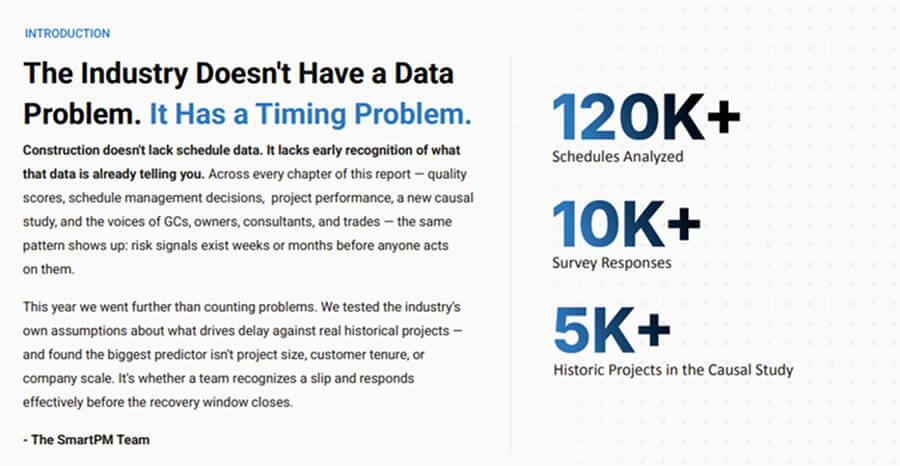
This US survey is useful for understanding the general practices in the US which draw many of the main lessons for the community as a whole. The US and the UK market are generally somewhat ahead of the curve in this area, so any problems in the US are generally magnified in the Polish market.
TOOLS OF THE TRADE:
The Construction Sector choice of tools is not keeping up with the technological change:. The progress in the sector and changes in technology are now very rapid, but the same tools are being used by most people, as this is what is available, or is being taught at the training centres. The sector is continuing to be far behind other sectors such as IT, manufacturing, production in general which can no longer survive without using more modern techniques such as:
- Critical Chain Modelling
- Risk Analysis and Scenarios
- Resource Driven Planning:
The modern techniques are complicated and are not being taught, nor utilised on a wide scale.
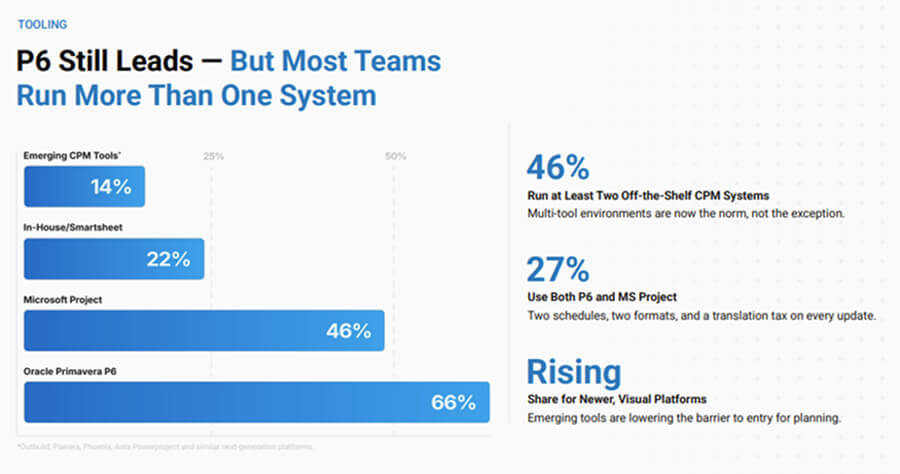
In the US where this survey was taken the dominant programme is P6 with Microsoft Project coming in second. In Poland it is the other way around with P6 dominating only in the EPC sector.
In the more advanced scheduling particularly associated with risk modelling more advanced tools are being introduced. The use of resource driven planning or critical chain planning is still very infrequently encountered.
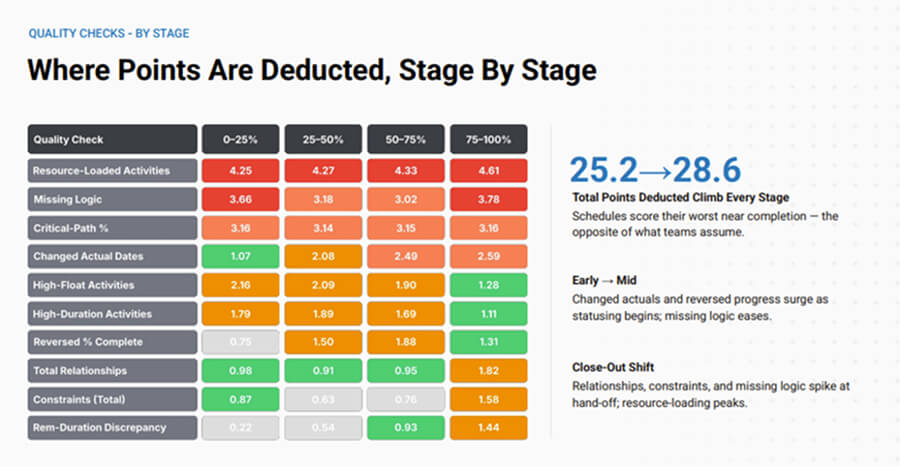
These are basically DCMA 14 point tests given a weighting to determine what was good or bad in terms of the scheduling: Based on the above the following was shown:
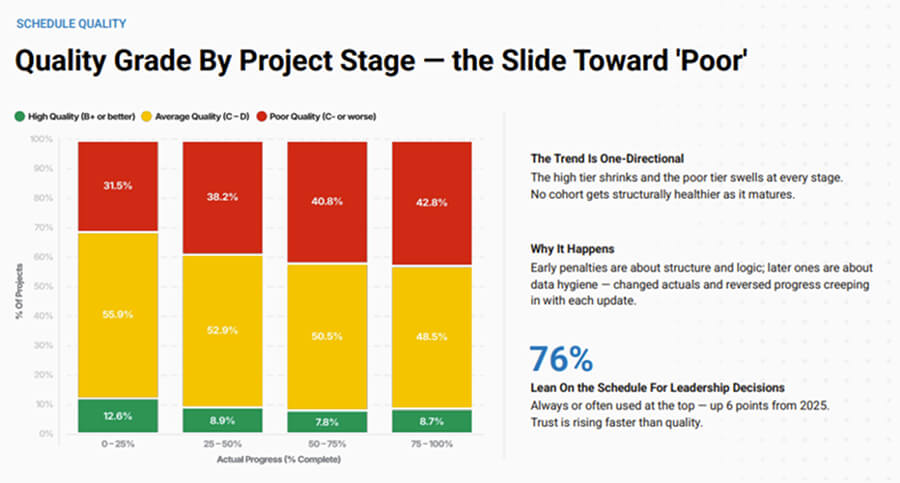
Key Issues Arising from the Survey:
Low Quality is General:
The number of good quality schedules in our view is generally below 10%. This is not normally the fault of the Planner, it is due to the lack of consideration given to the subject in the Training establishments when teaching Engineers. Additionally there is a tendency to ask around in Poland as to who has Microsoft Project on their laptop, which means they are the Planner. This is not really understood as a professional skill for experts in the sector.
The Complexity of the Model:
There are many thousands of discussions, facts, and planning processes as part of any large project. To summarise these into a few thousand or a few hundred positions is a complex task. Any programme is therefore a summary of something much more complicated. For the summary to be of high quality it is necessary for each position, to achieve the following:
- A reasonably well structured WBS
- Viable and reasonable assumptions relating to duration
- A data set that represents all the work to be done on the project
- A sensible and workable logic structure
- A mechanically correct base schedule
- A mechanically correct schedule update
To do the above correctly typically means making 5-7 correct statements about the tasks in the base position. It requires around 5-7 correct steps to be taken with the updating process. Gradually for the project to correctly show progress and to make sense, requires tens of thousands of reasonable steps by the Planner even if there are only a few thousand line items. This is statistically impossible if the Planner does not know exactly what he is doing.
AI & Power BI:
The hope for AI is that it can provide answers to the above instead of the Planner doing the hard work. This is an unreasonable expectation and the users do not yet trust AI to do this. It is not reasonable to expect AI to be able to correct an incorrect schedule.
The SmartPM survey data shows that people do not trust the AI to produce realistic schedules.
This is different from Power BI: Power BI can be used to assemble and present various data flows, not only project data, but also planning information, ERP information and these can be fed into analysis of data which has occurred in the past. This means that the past and the drivers of the past can to a significant degree be reviewed with Power BI and as a rule Power BI is not required to project the future.
SmartPM: Have developed software that analyses schedules and shows the basic weaknesses of the schedules at smartpm.com addressing the above issues. They show how most projects will show problems and compression related issues early on and shows ways of rectifying them. This is the problem in the US. In Poland the problem is mainly with quality of the schedules. If the schedule is of poor quality the inference drawn by automated systems will be meaningless unless the mechanical errors in the schedules themselves are removed. In many ways therefore the standards in the US and the UK are ahead of the Polish market in this area.